
For many people, accessing healthcare can involve a frustrating combination of searching for the right service, waiting for an appointment and trying to explain symptoms clearly. Artificial intelligence is beginning to change that experience. Instead of being something used only behind the scenes, AI is gradually becoming part of the patient journey, from finding appropriate care to supporting diagnosis and managing follow-up.
The purpose is not to replace doctors, nurses or other healthcare professionals. Instead, AI can handle certain tasks more efficiently, organise information and help patients navigate services with greater ease. As the technology develops, it could make healthcare more accessible, responsive and personalised while allowing professionals to spend more time focusing on the people they care for.
Why AI is Becoming Part of Modern Healthcare
Healthcare generates enormous amounts of information every day, from medical records and test results to appointment details and treatment histories. Traditionally, much of this information has had to be reviewed or processed manually.
AI can analyse and organise large volumes of information much faster, making it useful in areas where speed and consistency matter. It can help identify patterns, support administrative decisions and provide healthcare professionals with additional information when assessing a patient.
For patients, the benefits may be less about seeing AI directly and more about experiencing a smoother healthcare journey. Faster communication, easier appointment management and better-organised information can all contribute to a more efficient experience.
The important point is that technology works best when it supports clinical expertise rather than attempting to replace it.
How AI Can Help Patients Find the Right Care
Knowing where to seek help is not always straightforward. A patient experiencing a new symptom may be uncertain whether they should contact their GP, speak to a pharmacist, attend an urgent care service or seek emergency treatment.
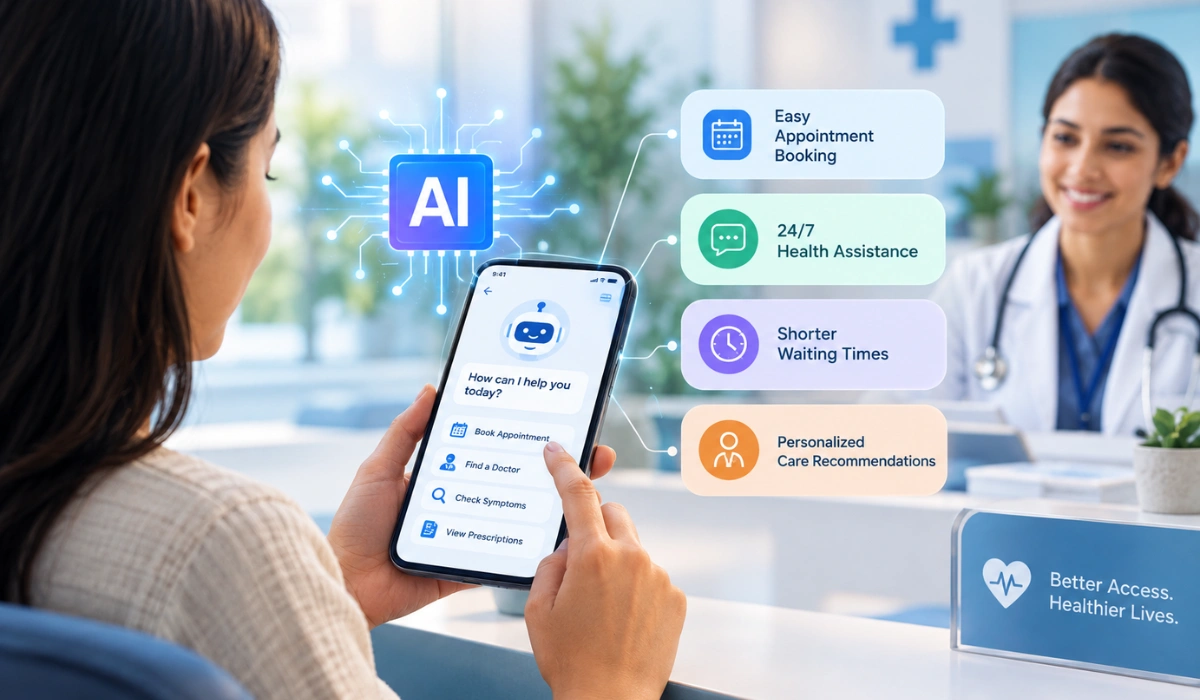
AI-powered healthcare tools can help make this process easier by asking patients relevant questions about their symptoms and circumstances. Based on the information provided, the system can help direct them towards an appropriate type of care.
This can be particularly useful outside traditional appointment hours, when a patient may need guidance but does not necessarily require immediate emergency treatment.
Making Healthcare Navigation Simpler
AI-assisted systems can potentially help patients:
- Describe their symptoms in a structured way.
- Identify which type of healthcare service may be appropriate.
- Find relevant information before an appointment.
- Reduce confusion when navigating different healthcare options.
- Receive basic guidance without waiting for an immediate appointment.
This does not mean an AI system can determine exactly what is wrong with someone. Symptoms can overlap between different conditions, and professional assessment remains important. Instead, the technology can act as a starting point that helps patients understand what they should consider doing next.
AI Could Make Appointments More Convenient
Booking an appointment can sometimes feel like a separate challenge from receiving healthcare itself. Patients may need to search for availability, call a practice, wait for confirmation or rearrange appointments when their circumstances change.
AI could make these processes more responsive. Instead of simply displaying available appointment slots, intelligent systems could potentially consider factors such as the type of appointment required, preferred times and location when helping patients find suitable options.
The same technology could assist with reminders, cancellations and follow-up communication. For healthcare providers, automating some routine administrative tasks could reduce pressure on reception and administrative teams.
For patients, the biggest benefit is convenience. Spending less time navigating administrative processes means more time can be focused on actually receiving care.
How AI is Improving Clinical Decision-Making
One of the most interesting applications of AI is its ability to work with large amounts of medical information. Healthcare professionals already rely on patient histories, test results, scans and clinical observations when making decisions. AI can provide another layer of support by helping identify patterns within this information.
For example, AI-assisted systems can be used to analyse medical images and highlight areas that may require closer attention. Similar approaches are being developed across different areas of healthcare, including screening and diagnostic services.
This can be particularly valuable when healthcare professionals are dealing with large amounts of information or need to identify subtle patterns quickly.
However, an AI-generated suggestion is not the same as a medical diagnosis. A clinician still needs to consider the patient’s symptoms, history and circumstances before deciding what the findings mean.
How AI Can Support Earlier Detection
Early detection can make a significant difference to many areas of healthcare. The sooner a potential problem is identified, the sooner appropriate investigations or treatment can begin.
AI may support earlier detection by analysing information that could otherwise take considerable time to review. This could include imaging, laboratory results, patient monitoring data or patterns within medical records.
Where AI May Support Earlier Detection
Potential applications include:
- Supporting the review of medical scans.
- Identifying changes in patient monitoring data.
- Highlighting information that may need further investigation.
- Helping clinicians prioritise cases requiring closer attention.
The value lies in giving professionals another tool rather than asking technology to make the final decision. A clinician can review the information, consider the wider clinical picture and decide whether further investigation is appropriate.
Giving Healthcare Professionals More Time for Patients
Some of AI’s biggest benefits may happen without patients even realising that technology is being used.
Healthcare professionals spend considerable time on documentation, administration and other tasks that are essential to providing care but do not involve direct patient interaction. AI can assist with activities such as transcription, note preparation, information organisation and routine administrative processes.
Reducing some of this workload could allow professionals to spend more time listening to patients, explaining treatment options and discussing concerns.
This distinction is important. The value of AI is not simply that it can complete certain tasks faster. Its real benefit could be giving healthcare professionals more time to concentrate on the parts of healthcare that require empathy, communication and professional judgement.
Can AI Make Healthcare More Personalised?
Healthcare has traditionally combined standard clinical guidelines with the experience and judgement of individual professionals. AI could add another dimension by helping clinicians make greater use of information relating specifically to each patient.
A digital system may be able to consider information from different parts of a patient’s healthcare history and identify patterns that could support a more personalised approach.
This could eventually help with:
| Area | How AI Could Support Care |
| Treatment planning | Identify relevant patterns within patient information |
| Medication management | Highlight potential concerns for professional review |
| Remote monitoring | Identify changes that may require attention |
| Preventive care | Help identify individuals who may benefit from closer monitoring |
| Follow-up | Support reminders and personalised care information |
Personalised healthcare does not mean that every patient will receive a completely different treatment. Instead, it means using available information more effectively to make care better suited to individual circumstances.
What Does AI Mean for Patient Privacy?
The increasing use of AI also creates important questions about privacy and data security. Healthcare information is highly sensitive, so patients need confidence that their information is collected, stored and used appropriately.
There are also concerns about accuracy. AI systems can make mistakes, misunderstand information or produce recommendations that require further investigation. For this reason, healthcare organisations need appropriate safeguards and professional oversight.
Another consideration is accessibility. Digital healthcare should not make traditional healthcare routes unavailable to people who are unable or unwilling to use digital tools.
A patient-centred approach means giving people more ways to access care, rather than forcing everyone into a single technology-based system.
The Human Side of AI-Powered Healthcare
Technology can improve speed and efficiency, but healthcare remains fundamentally human. Patients often need reassurance, empathy and the opportunity to explain concerns that cannot easily be reduced to data.
A well-designed AI system should therefore support the relationship between patients and healthcare professionals rather than create distance between them.
For example, if AI handles routine documentation during a consultation, the clinician may be able to maintain better eye contact and concentrate more fully on the conversation. If an intelligent system helps organise a patient’s information before an appointment, the professional may have more time to discuss the issues that matter most.
The technology becomes valuable because it creates more space for human interaction, not because it removes it.
What Could the Future of Healthcare Look Like?
The future healthcare journey could become increasingly connected. A patient might begin by using a digital tool to describe symptoms, receive guidance about the appropriate service and arrange an appointment. During the consultation, AI could help organise clinical notes, while digital diagnostic tools support the healthcare professional’s assessment.
After treatment, technology could assist with reminders, monitoring and follow-up, creating a more continuous connection between appointments.
This does not necessarily mean every part of healthcare will become automated. Some situations will always require face-to-face assessment, specialist expertise or urgent intervention. Instead, AI could take responsibility for certain repetitive or information-heavy tasks while healthcare professionals concentrate on decisions and interactions that require human judgement.
Final Thoughts
AI is changing the way patients access healthcare by making some parts of the journey faster, more convenient and more connected. From helping people navigate healthcare services to supporting diagnosis, administration and personalised care, the technology has the potential to improve both patient experiences and the way healthcare professionals work.
However, the most successful use of AI will not be about replacing human healthcare. It will be about combining technological capability with clinical expertise, empathy and patient choice. When used responsibly, AI can remove unnecessary barriers and give professionals better tools to provide effective care. The future of healthcare is therefore unlikely to be purely digital or purely traditional, but a combination of technology and human expertise working together.