
intelligence (AI) is technology that enables computers and software to perform tasks that normally require human intelligence, such as understanding language, recognizing images, finding patterns, making predictions, and generating content. In 2026, AI is being used across search, software, healthcare, education, business, cybersecurity, and many other areas.
AI is no longer something limited to research laboratories or science-fiction movies. It is already working behind many of the digital services people use every day, from spam filters and search engines to chatbots, recommendation systems, translation tools, and image generators.
But AI is also more complicated than simply asking a chatbot a question. Understanding how AI works, the different types of AI, where it is being used, and its limitations can help you make better use of the technology while avoiding common risks.
What is AI?
Artificial intelligence is the field of computer science focused on creating systems that can perform tasks associated with human intelligence.
These tasks can include understanding language, recognizing objects in images, identifying patterns, making predictions, solving problems, and generating new content.
AI is not a single technology. It includes many different approaches and systems, ranging from simple machine-learning models used for recommendations to large generative AI models capable of working with text, images, audio, video, and code.
Note: Most modern AI systems learn patterns from data and use those patterns to produce predictions, classifications, recommendations, or generated outputs.
What Are the Different Types of AI?
There are several ways to classify artificial intelligence. Two of the most common approaches are based on capability and functionality.
AI Types Based on Capability
| Type | What It Means |
| Narrow AI | Designed to perform specific tasks or a limited range of tasks |
| Artificial General Intelligence (AGI) | A hypothetical system capable of performing a broad range of intellectual tasks at a human level |
| Superintelligent AI | A hypothetical form of intelligence that would exceed human capabilities across essentially all intellectual domains |
Almost all AI systems available today fall into the narrow AI category. Even highly capable generative AI systems are designed around particular capabilities and do not constitute demonstrated human-level general intelligence across every domain.
AI Types Based on Functionality
Another traditional classification divides AI into four categories:
- Reactive machines: Systems that respond to current inputs without using stored experiences in the way more advanced systems do.
- Limited-memory AI: Systems that use information from previous observations or data to make decisions.
- Theory of mind AI: A proposed type of AI that could understand human emotions, beliefs, and intentions in a deeper way.
- Self-aware AI: A hypothetical system with consciousness or self-awareness.
The last two categories remain theoretical rather than established forms of AI technology.
How Does AI Work?
Modern AI systems generally learn patterns from data instead of relying entirely on manually written rules.
A simplified AI workflow looks like this:
- Data collection: Data such as text, images, audio, video, or numerical information is gathered.
- Training: An algorithm processes the data and learns patterns or relationships.
- Model development: Those learned patterns are represented within a trained model.
- Inference: The model applies what it learned to new information and produces an output.
- Evaluation and improvement: Developers test the system, identify weaknesses, and improve the model or its surrounding systems.
For example, an image-recognition system can be trained using large numbers of labeled images. After training, it can analyze a new image and estimate what objects or patterns it contains.
This also explains why AI can make mistakes. A model can produce a convincing answer without actually knowing whether that answer is true.
Where is AI Used Today?
AI is already being used across consumer technology, business, healthcare, finance, transportation, education, and scientific research.
Some common applications include:
- Chatbots and virtual assistants for customer service, research, scheduling, and everyday questions
- Content generation for text, images, audio, video, and software code
- Search and recommendations for finding information and personalizing digital experiences
- Fraud detection for identifying unusual or potentially suspicious financial activity
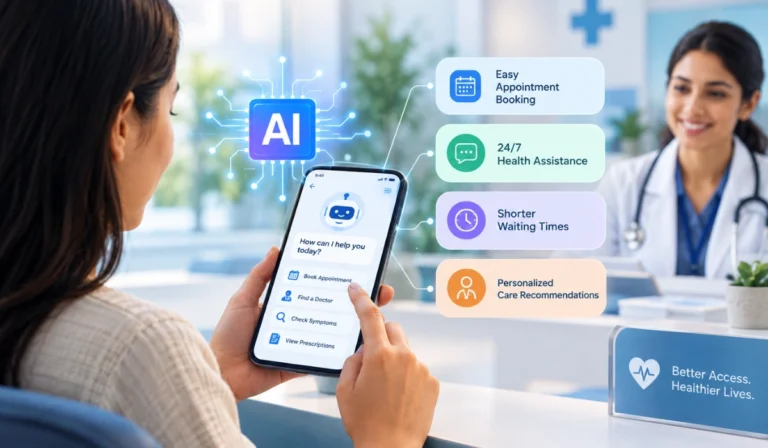
- Healthcare for medical imaging, research, drug discovery, clinical support, and patient-facing applications
- Transportation for driver-assistance and autonomous-driving systems
- Business automation for tasks such as document processing, meeting summaries, data analysis, and workflow management
- Cybersecurity for detecting unusual activity and helping security teams investigate threats
AI is also becoming increasingly important in scientific research. Stanford’s 2026 AI Index reports that AI-related scientific publications continue to grow and that researchers are applying AI across fields including biology, chemistry, physics, and astronomy.
Real-World Examples of AI
AI can be easier to understand when you look at where it is already being used.
AI Chatbots
Generative AI systems can answer questions, summarize information, help with writing, assist with coding, and perform other language-based tasks.
AI in Healthcare
AI systems can assist with medical-image analysis, scientific research, drug discovery, and other healthcare applications. These systems are generally designed to support professionals or specific workflows rather than replace medical judgment.
AI in Fraud Detection
Banks and financial institutions can use machine-learning systems to identify unusual transaction patterns and flag activity that may require further investigation.
AI in Autonomous Vehicles
Self-driving and driver-assistance systems use AI and other technologies to interpret information from cameras, sensors, maps, and other inputs to understand the surrounding environment and make driving-related decisions.
AI-Generated Fraud
The same technology that can generate useful content can also be misused. AI-generated voices, images, and videos can make impersonation scams more convincing, creating new challenges for individuals and organizations.
10 AI Trends to Watch in 2026
AI development is moving beyond simple question-and-answer chatbots. Current research and industry data point toward several important developments.
1. Agentic AI
AI systems are increasingly being designed to perform sequences of actions rather than simply respond to individual prompts. These systems can plan tasks, use tools, retrieve information, and work through multi-step processes. However, real-world deployment of AI agents is still developing. Stanford’s 2026 AI Index notes that agent use in business remained relatively early compared with broader organizational AI adoption.
2. Multimodal AI
AI systems are increasingly able to work across multiple forms of information, including text, images, audio, video, and code. This allows a single system to interpret different types of input and generate different types of output.
3. Smaller and More Specialized AI Models
AI development is not only about building larger models. Smaller models optimized for particular tasks are becoming increasingly important because they can be cheaper to operate and easier to deploy for specific use cases. Industry analysis also points toward smaller, more efficient models that can be tuned for particular domains.
4. AI Built Into Everyday Software
AI is increasingly being integrated directly into software people already use rather than existing only as separate AI applications. Email, productivity software, browsers, development tools, operating systems, and business platforms are increasingly adding AI-powered features.
5. AI-Powered Cybersecurity
AI is being used by defenders to identify suspicious activity, analyze security events, and automate parts of threat detection. At the same time, attackers can use AI to create more convincing phishing messages, automate parts of their operations, and produce deceptive content. This makes the relationship between AI and cybersecurity increasingly important.
6. AI in Science
AI is becoming a research tool across areas such as chemistry, biology, physics, and astronomy. The 2026 Stanford AI Index includes a dedicated science chapter for the first time, reflecting the growing role of AI in scientific research.
7. AI in Healthcare
Healthcare is another major area of AI development, including medical imaging, drug discovery, clinical applications, and patient engagement. The technology is developing quickly, but accuracy, validation, privacy, and human oversight remain important considerations.
8. On-Device AI
More AI processing is moving directly onto smartphones, computers, and other devices. Running models locally can reduce dependence on cloud services and may improve response times and privacy for certain applications.
9. AI Regulation and Governance
Governments and institutions are developing rules and frameworks covering issues such as AI safety, transparency, accountability, privacy, and responsible deployment. Stanford’s 2026 AI Index identifies AI governance and national AI strategies as increasingly important parts of the global AI landscape.
10. AI Infrastructure and Energy Demand
Behind every advanced AI system is a large infrastructure ecosystem involving processors, data centers, networking, storage, and electricity. Stanford’s 2026 AI Index reports substantial growth in AI computing capacity alongside increasing environmental and infrastructure concerns.
What Are the Risks and Limitations of AI?
AI can be useful, but it is not infallible.
Some of the major limitations and risks include:
- Hallucinations: AI can produce information that sounds convincing but is incorrect.
- Bias: Models can reproduce or amplify patterns and biases present in their data or development processes.
- Privacy: Some AI applications involve processing personal, confidential, or sensitive information.
- Security: AI can be used to create more sophisticated scams, phishing attacks, and other security threats.
- Job disruption: Automation can change the tasks people perform and affect employment differently across industries.
- Over-reliance: People may accept AI-generated information without checking whether it is accurate.
The reliability problem is particularly important. Stanford’s 2026 AI Index reports substantial variation in hallucination rates across leading models and notes that responsible-AI evaluation is not advancing as quickly as capability evaluation.
Also Read: What is a Cyber Threat? Top 10 Cybersecurity Threats in 2026
How to Use AI Safely and Effectively
Using AI effectively is not only about writing better prompts. It also requires knowing when to verify the output and when not to share information.
Things to Do
- Verify important information: Check facts, figures, sources, and claims before relying on AI output.
- Protect sensitive information: Avoid entering passwords, financial information, confidential business data, or other sensitive information into public AI tools unless you understand how that information is handled.
- Use AI as an assistant: Let AI help with research, brainstorming, summarization, and repetitive work while keeping human review where accuracy matters.
- Check important decisions: Medical, financial, legal, employment, and other high-impact decisions require appropriate professional or authoritative sources.
- Keep learning: AI tools change quickly, so features, limitations, and usage policies can change over time.
AI vs. Machine Learning vs. Deep Learning
These three terms are related but do not mean the same thing.
| Term | Meaning |
| Artificial Intelligence (AI) | The broad field of creating systems that perform tasks associated with intelligence |
| Machine Learning (ML) | A subset of AI in which systems learn patterns from data |
| Deep Learning | A subset of machine learning that uses multi-layer neural networks |
A simple way to remember the relationship is: AI → Machine Learning → Deep Learning
Deep learning powers many modern applications involving language, images, speech, and other complex data.
Frequently Asked Questions About AI
Is AI the same as a robot?
No. A robot is a physical machine, while AI is software or a computational system that can perform tasks associated with intelligence. A robot can use AI, but AI can also operate entirely inside software.
Can AI think like a human?
Current AI systems can perform many tasks associated with human intelligence, but that does not mean they have human consciousness, emotions, or understanding. Their capabilities come from computational models trained and developed using data and algorithms.
Will AI replace all jobs?
AI is changing the tasks people perform and may reduce demand for some activities while increasing demand for others. The effect varies significantly by occupation, industry, and the specific tasks involved. Current evidence does not support a simple conclusion that AI will replace all jobs.
Is AI-generated information always accurate?
No. AI systems can generate incorrect information, including statements that sound confident and plausible. Important information should be independently verified.
Is AI safe to use?
AI can be useful, but safety depends on the application, the information being processed, the system’s reliability, and how its output is used. Sensitive information should be handled carefully, and important outputs should be verified.
What AI Means for the Future
AI is moving from a specialized technology into a general-purpose tool used across everyday products, businesses, scientific research, healthcare, and education.
The biggest change may not be AI replacing everything people currently do. Instead, AI is likely to change how many existing tasks are performed, from searching for information and writing software to analyzing data, conducting research, and supporting professional workflows.
That makes understanding AI increasingly important. Knowing what these systems can do, where they can fail, and how to use them responsibly will help people navigate a technology that is likely to remain a major part of the digital world.
The future of AI will depend not only on how capable the technology becomes, but also on how people, businesses, researchers, and governments choose to develop and use it.